

-
12
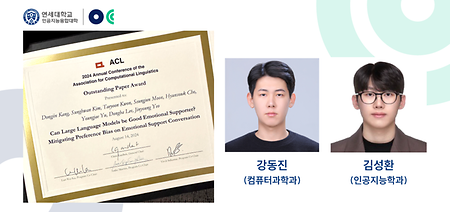
- Dongjin Kang andSunghwan Kim from the Department of Artificial Intelligence DLI Lab have won the ACL 2024 (2024-08-28)
- Dongjin Kang andSunghwan Kim from the Department of Artificial Intelligence DLI Lab have won the ACL 2024 Outstanding Paper Award. “Can Large Language Models be Good Emotional Supporter? Mitigating Preference Bias on Emotional Support Conversation”, {Dongjin Kang, Sunghwan Kim}, Taeyoon Kwon, Seungjun Moon, Hyunsouk Cho, Youngjae Yu, Dongha Lee, Jinyoung Yeo, ACL 2024, Outstanding Paper Award Link: : https://arxiv.org/abs/2402.13211
- 첨단컴퓨팅공학부 2025.01.14
-
11
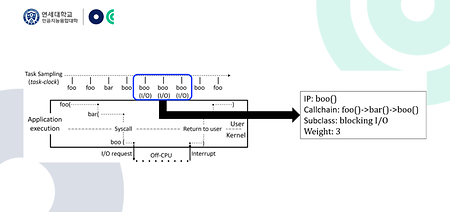
- Professor Jinkyu Jeong's lab (Scalable Systems Software Lab) presented two papers at top-tier international (2024-08-02)
- Professor Jinkyu Jeong's lab (Scalable Systems Software Lab) presented two papers at top-tier international conferences in the field of systems software (OSDI '24, USENIX ATC '24) Professor Jinkyu Jeong's lab (Scalable Systems Software Lab) presented two papers at top-tier international conferences in the field of systems software (OSDI '24, USENIX ATC '24) In July 2024, the Scalable Systems Software Lab at Yonsei University, led by Professor Jeong, presented a paper at the 18th USENIX Symposium on Operating Systems Design and Implementation (OSDI '24), the top international conference in the field of operating systems. The paper titled “Identifying On-/Off-CPU Bottlenecks Together with Blocked Samples” introduces the Blocked Samples technique, a key innovation that greatly simplifies application performance profiling in today’s increasingly diverse and complex computer systems. The research presents two application performance profilers, bperf and BCOZ, which leverage this technique. These profilers are valuable tools for optimization as they pinpoint bottlenecks that lead to performance improvements when addressed. The research team demonstrated the utility of these profilers by profiling and optimizing the performance of large-scale language model inference and NoSQL big data storage systems. Additionally, the Blocked Samples technique reduces application performance interference by up to 17 times compared to similar existing profiler tools. Additionally, Professor Jeong’s research team presented a paper at the 2024 USENIX Annual Technical Conference (USENIX ATC '24), a flagship international conference in the field of system software, which was held alongside OSDI '24. The paper titled “A Secure, Fast, and Resource-Efficient Serverless Platform with Function REWIND” identifies security issues caused by container (or sandbox) reuse techniques used to enhance performance in commercial serverless cloud platforms like Amazon Lambda and Google Cloud Functions. The paper introduces the REWIND technique, which addresses these security concerns while simultaneously improving performance and reducing memory usage. This approach selectively rewinds only the memory and file regions that could cause security issues after executing a serverless function within a serverless container. By doing so, it eliminates any residual user privacy data, ensuring security, while significantly reducing the memory usage required to maintain this security. The research team demonstrated that, across various real-world cloud workloads, the proposed technique maintains near-zero performance loss compared to less secure execution methods and reduces memory usage by more than half. Links: Identifying On-/Off-CPU Bottlenecks Together with Blocked Samples, https://www.usenix.org/conference/osdi24/presentation/ahn A Secure, Fast, and Resource-Efficient Serverless Platform with Function REWIND, https://www.usenix.org/conference/atc24/presentation/song
- 첨단컴퓨팅공학부 2025.01.14
-
10
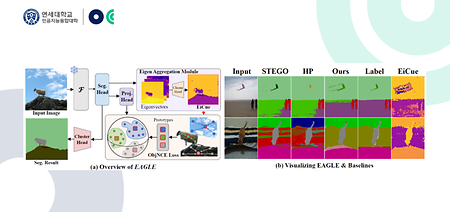
- Professor Seong Jae Hwang's Research Team Selected as Highlight Paper at CVPR 2024 (2024-05-23)
- A paper by Professor Seong Jae Hwang's research team, titled "EAGLE: Eigen Aggregation Learning for Object-Centric Unsupervised Semantic Segmentation," has been selected as a Highlight Paper at CVPR 2024, the top-tier international conference in the field of AI and computer vision. This achievement places it in the top 2.8% of all submitted papers. This research addresses the issue that existing methods do not consider object-level representation during training, proposing a new methodology to implement unsupervised semantic segmentation with object-centric representation. This method uses the eigenbasis of the Graph Laplacian to obtain clues about objects and conducts contrastive learning based on these clues. The research was conducted under the guidance of Professor Seong Jae Hwang(Dept. of AI), with contributions from Chanyoung Kim (Dept. of AI), Woojung Han (Dept. of CS), and Dayun Ju (Dept. of CS). Link: EAGLE: Eigen Aggregation Learning for Object-Centric Unsupervised Semantic Segmentation: https://arxiv.org/abs/2403.01482
- 첨단컴퓨팅공학부 2025.01.14
-
9
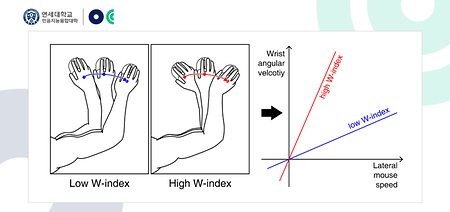
- Two of Four Papers Presented by Yonsei Esports Lab at CHI 2024 Win Best Paper Honorable Mention Award (2024-05-03)
- Two of Four Papers Presented by Yonsei Esports Lab at CHI 2024 Win Best Paper Honorable Mention Award In May 2024, Yonsei Esports Lab, supervised by Professor Byungjoo Lee, will present four papers at CHI 2024, a premier international conference of Human-Computer Interaction. "Quantifying Wrist-Aiming Habits with A Dual-Sensor Mouse: Implications for Player Performance and Workload" paper presents a technique to quantify the extent of a player's wrist-aiming habits using a mouse equipped with two optical sensors and examines the relationship between wrist-aiming habits and player performance or workload. "Characterizing and Quantifying Expert Input Behavior in League of Legends" paper demonstrates a holistic pipeline of input behavior analysis from characterizing and quantifying the quality of League of Legends players’ input skills to providing actionable lessons with players based on visualization of input behavior. "Real-time 3D Target Inference via Biomechanical Simulation" paper proposes a novel approach that leverages biomechanical simulation to produce synthetic motion data, capturing a variety of movement-related factors, such as limb configurations and motor noise. "User Performance in Consecutive Temporal Pointing: An Exploratory Study" paper broadly explores user performance in a variety of Consecutive temporal pointing (CTP) scenarios and finds CTP is a unique task that cannot be considered as two ordinary temporal pointing processes. Among them, two papers won the Best Paper Honorable Mention Award, which is only awarded to the top 5% of papers. Link: Quantifying Wrist-Aiming Habits with A Dual-Sensor Mouse: Implications for Player Performance and Workload (Best Paper Honorable Mention Award) : https://programs.sigchi.org/chi/2024/program/content/146862 Characterizing and Quantifying Expert Input Behavior in League of Legends : https://programs.sigchi.org/chi/2024/program/content/148156 Real-time 3D Target Inference via Biomechanical Simulation (Best Paper Honorable Mention Award) : https://programs.sigchi.org/chi/2024/program/content/147400 User Performance in Consecutive Temporal Pointing: An Exploratory Study : https://programs.sigchi.org/chi/2024/program/content/147090
- 첨단컴퓨팅공학부 2025.01.14
-
8
- DLI lab student Hyungjoo Chae from the Department of Artificial Intelligence publishes research results ... (2024-04-09)
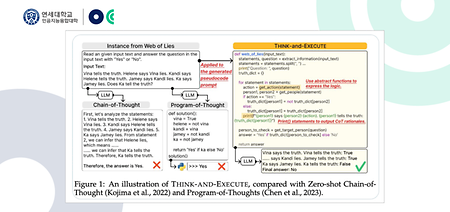
- DLI lab student Hyungjoo Chae from the Department of Artificial Intelligence publishes research results on Large Language Models that surpasses Google DeepMind In April 2024, Hyungjoo Chae, a DLI lab student supervised by Professor Jinyoung Yeo, pre-published his latest research on Arxiv, drawing significant attention for its reasoning capabilities that far exceed those of Google DeepMind's "Self-Discover" framework. Notably, this research was introduced by famous Twitter influencers in the AI field, attracting intense interest with approximately 35,000 views. The research focuses on the ability of large language models (LLMs) to develop and utilize algorithms to solve problems, proposing a new methodology. The joint research team of Professor Jinyoung Yeo and Professor Youngjae Yu proved that this allows language models to solve complex problems more effectively. Moreover, the proposed methodology indicates a significant advantage by demonstrating cost-effective reasoning where massive and small language models work together. Link: https://huggingface.co/papers/2404.02575 https://twitter.com/_akhaliq/status/1775743181885186214
- 첨단컴퓨팅공학부 2025.01.14
-
7
- Professor Baek Jong-duk's research team has been selected for the Korea Research Foundation's STEAM ... (2023-05-22)
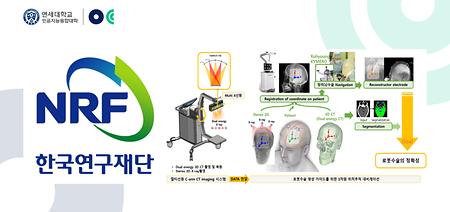
- Professor Baek Jong-duk's research team has been selected for the Korea Research Foundation's STEAM Research Project (Bridge Convergence Research and Development) Professor Baek Jong-duk's research team has been finally selected for the Korea Research Foundation's STEAM Research Project. From April 2023 to December 2026 (3 years and 9 months), they will receive a total research grant of 3.025 billion Korean Won and lead the research team as the head of the 'High-Precision Robotic Surgery Image Guidance Technology AI Convergence Research Group.' In this research, the robotic surgery company, GoYoung Technology, the neurosurgery team at Seoul National University Hospital led by Professor Pi Ji-hoon, and the AI Graduate School at KAIST led by Professor Shim Hyun-jeong will participate as collaborative research institutions. Through this project, the research team will receive comprehensive support from technology development to commercialization, and in particular, during Phase 2 (January 2025 to December 2026), Professor Baek Jong-duk's academic startup, Barnes Imaging Co., Ltd., will participate in technology enhancement and joint development for business implementation
- 첨단컴퓨팅공학부 2025.01.14
-
6
- A paper by Prof. Song’s team accepted to USENIX Security ‘23 (2023-05-22)
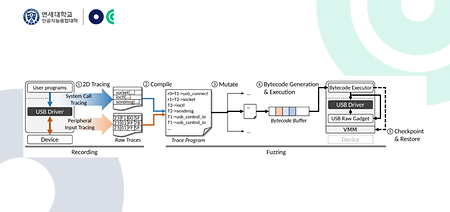
- The research group led by Prof. Song has their paper accepted to appear in one of the top-tier security conferences, the USENIX Security Symposium 2023. The accepted paper titled 'ReUSB: Replay-Guided USB Driver Fuzzing' is co-authored by Jisoo Jang and Minsuk Kang, students in the department of Computer Science advised by Prof. Song. In this paper, they proposed a technique that combines Record-and-Replay with Fuzzing to discover bugs in deep kernel driver code, leveraging the fact that Record-and-Replay can trigger deep kernel driver code paths. They consider the timing and concurrency of inputs to improve the accuracy of replay, and perform dynamic scheduling of inputs, demonstrating the ability to uncover previously unknown vulnerabilities in deep driver code paths. In particular, they discovered a total of 15 undisclosed vulnerabilities in the Linux kernel, including CVE-2022-3628 and CVE-2023-1380, two Common Vulnerabilities and Exposures (CVE) numbers assigned to security vulnerabilities. They also took the lead in patching these vulnerabilities, ensuring that all vulnerabilities are patched in the latest Linux kernel. Jisoo Jang, Minsuk Kang, and Dokyung Song, “ReUSB: Replay-Guided USB Driver Fuzzing”, 32nd USENIX Security Symposium (USENIX Security), August 2023. (To appear.)
- 첨단컴퓨팅공학부 2025.01.14
-
5

- The Department of Artificial Intelligence has won three awards at the 29th Samsung Human-Tech Paper Awards (2023-04-24)
- The Department of Artificial Intelligence has won three awards at the 29th Samsung Human-Tech Paper Awards The Department of Artificial Intelligence at the College of Computing won a total of three awards, including the special award for the most awards per professor, at the 29th Samsung Human-Tech Paper Awards ceremony held on February 20th. In the "Computer Science & Engineering" category, Kwon Minki and Jeong Jaeseok, both of whom are students in the integrated master's and doctoral program (supervised by Professor Eo Young-jeong), won the gold and encouragement awards, respectively, while Cho Min-joo and Guksungji, both of whom are master's degree students (supervised by Professor Park No-sung), also won the gold and encouragement awards, respectively. Kwon Minki and Jeong Jaeseok, who won the gold award, discovered a new latent space of diffusion models and proposed a method for generating various real images using this space without retraining the model, demonstrating that it works on a wide range of datasets without being limited by the architecture. The discovery of the new latent space opens up a wide range of possibilities for research and practical applications. Cho Min-joo and Guksungji proposed a method for reinterpreting the Hawkes process based on differential equations. In particular, they extended the interpretation of discrete event occurrence times in deep learning-based Hawkes processes to a continuous method, demonstrating that the model can effectively handle irregular event data while improving performance. The Samsung Human-Tech Paper Awards have been held every year since 1994 by Samsung Electronics to discover and foster outstanding human resources in the field of science and technology. This year, 118 excellent papers were selected from a total of 1,972 papers. The "Computer Science & Engineering" category had the highest number of submissions with 323 papers, of which 8 were awarded.
- 첨단컴퓨팅공학부 2025.01.14
-
4
- Professor Seon Joo Kim appointed as an Associate Editor of IEEE TPAMI (2023-04-24)
- Professor Seon Joo Kim appointed as an Associate Editor of IEEE TPAMI Professor Seon Joo Kim joined the IEEE Transactions on Pattern Analysis and Machine Intelligence (TPAMI) Editorial Board as an Associate Editor. IEEE TPAMI is one of the top journals in Computer Science (Artificial Intelligence) with an impact factor of 24.31. Professor Seon Joo Kim will serve in the editorial board for the next 3 years. Professor Seon Joo Kim is also serving in the Editorial Board of International Journal of Computer Vision (IJCV), one of the top journals in computer vision.
- 첨단컴퓨팅공학부 2025.01.14
-
3
- Han Min-a, a postdoctoral researcher in Professor Baek Jong-deok's lab, has been finally selected as a ... (2023-04-24)
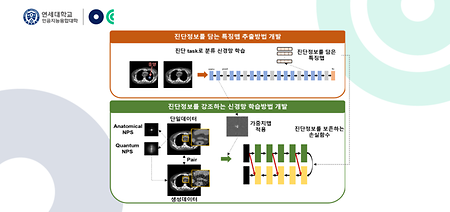
- Han Min-a, a postdoctoral researcher in Professor Baek Jong-deok's lab, has been finally selected as a Sejong Science Fellowship Yonsei University's postdoctoral researcher Han Mina has been selected as the final recipient for the 2023 Sejong Science Fellowship in the field of computer science and artificial intelligence applications, funded by the Ministry of Science and ICT's individual basic research project. The Sejong Science Fellowship is a program that encourages young scientists, including postdoctoral researchers, to immerse themselves in research and become core scientific and technological talents by supporting them with approximately KRW 500 million of research funds over a total of five years. Han Mina received her undergraduate degree from Yonsei University and completed her master's and doctoral degrees in the laboratory of Professor Baek Jong-duk. In particular, she has published a total of nine papers in SCI-level international journals as the first author, including the paper "Evaluation of tumor detection accuracy in 3D CT images," which was selected as an Editor's Choice in 2018 in the top medical physics journal. Through this Sejong Science Fellowship, Han Mina will conduct research on "Development of AI-based CT image processing technology for reducing patient radiation exposure." The research project aims to develop image quality improvement technology that enables low-dose CT scanning while maintaining diagnostic performance and to solve the problem of securing learning data by developing data generation methods for medical AI training.
- 첨단컴퓨팅공학부 2025.01.14